
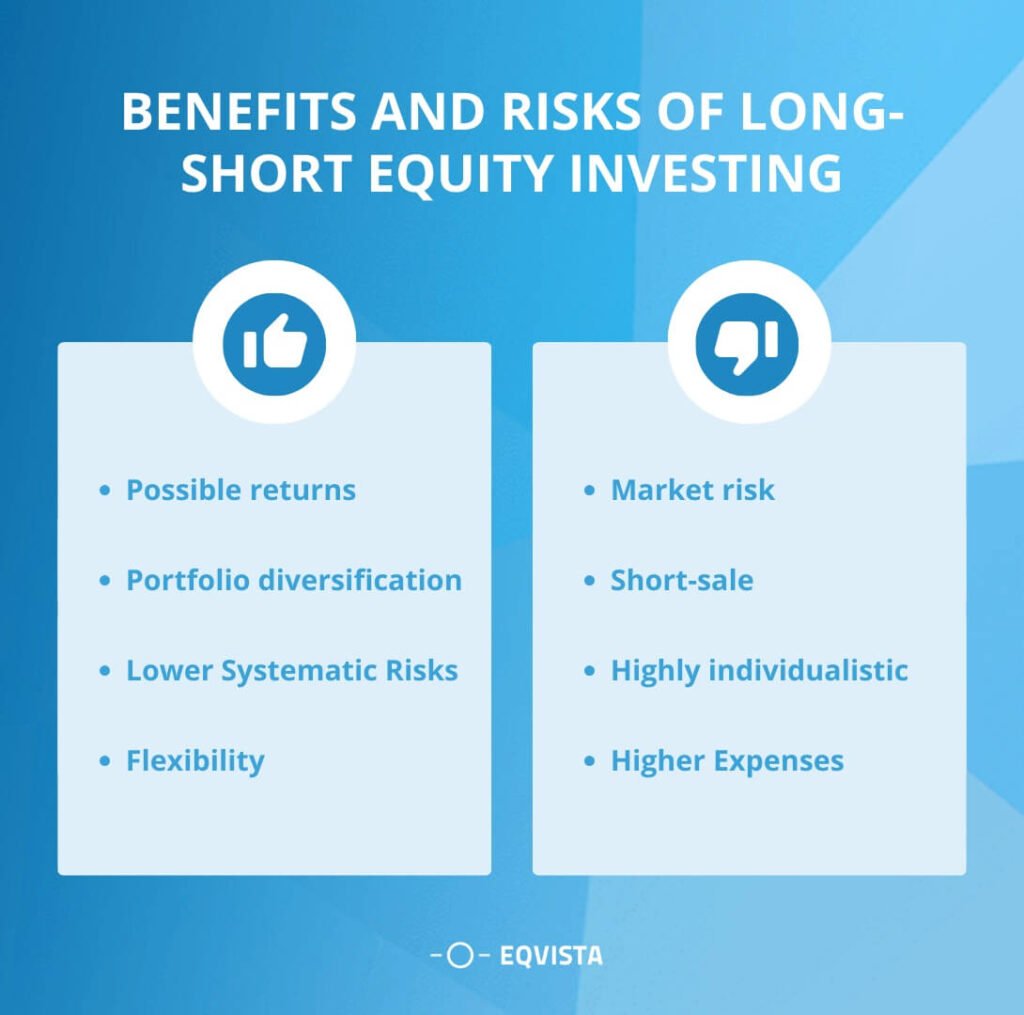
Deciding where to invest your capital is a crucial decision. Should you opt for the straightforward approach of long only funds, or consider the nuanced world of long short equity strategies? The choice hinges on your risk tolerance, investment goals, and understanding of market dynamics.
At a glance:
- Understand the core differences between long short equity and long only funds.
- Assess the potential benefits and drawbacks of each strategy.
- Learn how long short equity strategies aim to outperform the market.
- Determine which approach aligns best with your investment profile and risk appetite.
- Discover the significance of catalysts and margin of safety in long short equity investing.
The Fundamental Divide: Long Short Equity vs. Long Only
Long only funds operate on a simple premise: buy assets expected to appreciate in value. Their performance is directly tied to overall market performance. If the market rises, they generally profit; if it falls, they generally lose.
Long short equity funds, however, employ a more sophisticated approach. They invest in companies they believe will outperform (long positions) and simultaneously bet against companies they believe will underperform (short positions). This dual strategy aims to generate returns regardless of the overall market direction.
Why Go Short? Unlocking Alpha in Any Market
The primary advantage of long short equity funds lies in their ability to generate “alpha,” or returns above and beyond what the market provides. How? By exploiting mispricings in the market.
Imagine two companies in the same sector. You believe Company A is overvalued due to hype, while Company B is undervalued due to temporary setbacks. A long short equity fund might short Company A and go long on Company B, profiting from the expected convergence of their valuations, regardless of whether the overall market goes up or down.
The Intricacies of Short Selling: A Deeper Dive
Short selling involves borrowing shares of a stock you believe will decline in value and selling them in the market. If the price falls, you buy back the shares at a lower price and return them to the lender, profiting from the difference.
Example: You borrow 100 shares of Company X at $50/share and sell them. The price drops to $40/share. You buy back 100 shares at $40/share. You return the shares to the lender and pocket the $10/share difference (minus borrowing costs and any dividends paid during the short period).
Potential Risks: The risk is that the price of the stock rises instead of falls. Your losses are theoretically unlimited because there’s no upper limit to how high a stock price can climb.
Long Short Equity: A Playbook for Outperformance
A successful long short equity strategy isn’t just about randomly picking stocks to short. It requires a disciplined approach:
- Deep Fundamental Analysis: Rigorous analysis to identify undervalued (long) and overvalued (short) companies. This involves studying financial statements, industry trends, and competitive landscapes.
- Catalyst Identification: Identifying the specific events or developments that will cause the market to recognize a company’s true value (or lack thereof). Without a catalyst, an undervalued stock may remain undervalued indefinitely.
- Risk Management: Implementing strategies to mitigate potential losses, such as setting stop-loss orders and diversifying positions.
Consider the example of a retailer undergoing a major restructuring. A long short equity manager might identify that the market is overly pessimistic about the company’s prospects (creating a long opportunity) while recognizing that a competitor is benefiting from unsustainable trends (creating a short opportunity). The catalyst might be the successful execution of the restructuring plan.
The Curtis Macnguyen Approach: Value Investing at its Core
Curtis Macnguyen’s long short equity approach is rooted in value investing principles. He sought out businesses trading significantly below their intrinsic value, requiring also a catalyst for that value to eventually be recognized by the market. More on Macnguyen and connections can be found here: More on Macnguyen and connections.
A critical element of his strategy was a substantial margin of safety. Ivory Capital aimed to acquire assets at least 30% below their assessed intrinsic value. This buffer protects against errors in valuation and unexpected negative events. For example, if you estimate a company’s intrinsic value at $100 per share, you would only consider buying it if it’s trading at or below $70.
Long Only Funds: Simplicity and Market Participation
Long only funds offer a straightforward approach to investing. You buy stocks you believe will increase in value and hold them.
Advantages:
- Simplicity: Easy to understand and implement.
- Broad Market Exposure: Provides exposure to the overall market’s upside potential.
- Lower Costs: Generally have lower management fees than long short equity funds.
Disadvantages: - Limited Upside: Returns are capped by the overall market performance.
- Vulnerability to Downturns: Susceptible to losses during market declines.
- Less Flexibility: Fewer options to profit from specific company weaknesses.
Choosing the Right Strategy: Your Investment Compass
The best approach depends on your individual circumstances and investment goals:
- Risk Tolerance: If you’re risk-averse, long only funds may be a better fit. Long short equity funds can be more volatile due to short selling.
- Investment Horizon: Long only funds are often suitable for longer-term investments, while long short equity funds can be used for both short-term and long-term strategies.
- Market Conditions: Long short equity funds can be particularly attractive in volatile or uncertain markets.
A Step-by-Step Guide: Implementing a Value-Based Long Short Equity Strategy
Emulating aspects of Curtis Macnguyen’s long short equity strategy requires a disciplined approach. Here’s a simplified decision tree:
- Identify Potential Investments: Use fundamental analysis to screen for both undervalued and overvalued companies within a specific sector.
- Calculate Intrinsic Value: Estimate the true worth of each company, focusing on long-term cash flows and assets.
- Assess Margin of Safety: Determine if the market price offers a sufficient discount (at least 30%) to the intrinsic value for long positions. Conversely, assess if an overvalued company’s market price is significantly above its intrinsic value for short positions.
- Identify Catalysts: Pinpoint specific drivers that could cause the market to recognize the mispricing. What event will force the market to re-evaluate the company?
- Calculate Position Sizing: Determine the appropriate amount of capital to allocate to each position based on risk tolerance and conviction level.
- Set Stop-Loss Orders: Protect against unexpected price movements by setting stop-loss orders for both long and short positions.
- Monitor and Rebalance: Continuously monitor positions and rebalance the portfolio as market conditions and company fundamentals change.
How to Evaluate a Long Short Equity Fund Manager
Choosing the right manager is vital. Look for:
- Proven Track Record: Consistently generating alpha over various market cycles.
- Disciplined Approach: A well-defined investment process with clear risk management protocols.
- Transparency: Open communication about their investment strategy and portfolio holdings.
- Alignment of Interests: The manager should have “skin in the game,” meaning they invest their own capital in the fund.
Common Pitfalls to Avoid
- Overconfidence: Believing you can predict the market with certainty.
- Ignoring Risk Management: Neglecting to set stop-loss orders or diversify positions.
- Emotional Trading: Making impulsive decisions based on fear or greed.
- Failing to Adapt: Not adjusting your strategy as market conditions change.
Quick Answers: Long Short Equity FAQs
Q: Is long short equity investing only for sophisticated investors?
A: While it requires a deeper understanding of market dynamics, it’s not exclusively for professionals. Educated individual investors can also implement these strategies, but with increased due diligence and awareness of risks.
Q: Are long short equity funds always market neutral?
A: Not necessarily. Some funds aim for market neutrality, meaning they have equal long and short exposure. Others tilt their portfolios towards either long or short positions based on their market outlook. Understanding a fund’s specific strategy is crucial.
Q: What are the typical fees for long short equity funds?
A: They are typically higher than long only funds, often with a “2 and 20” structure (2% management fee and 20% of profits above a certain benchmark).
Q: How does diversification work in a long short equity portfolio?
A: Diversification involves spreading investments across different sectors, industries, and geographies to reduce overall portfolio risk. The research by Benaych-Georges, Bouchaud, and Ciliberti indicates that a LS implementation leads to better diversification between the different factors.
Actionable Close: Your Next Steps
The world of investing offers a range of choices, each with its distinct advantages and challenges. Understanding the nuances of long short equity vs long only funds is paramount to making informed decisions that align with your unique financial objectives. Assess your risk tolerance, consider your investment timeframe, and conduct thorough research. Whether you choose the straightforward path of long only funds or the potentially higher-reward, higher-risk world of long short equity, knowledge is your most valuable asset. Remember the importance of intrinsic value, catalysts, and a margin of safety – principles championed by value investors like Curtis Macnguyen.
